Zena Wozniak, Author at HUM Nutrition Blog https://www.humnutrition.com/blog/author/zena-wozniak/ The Wellnest | Beauty From The Inside Out Fri, 06 Jan 2023 17:38:54 +0000 en-US hourly 1 https://wordpress.org/?v=6.7.4 What Our Asian Mothers Taught Us About Beauty and Wellness https://www.humnutrition.com/blog/beauty-wellness-advice-asian-mothers/ Fri, 14 May 2021 19:41:20 +0000 https://www.humnutrition.com/blog/?p=24469 In honor of AAPI Heritage Month, members of Team HUM share beauty and wellness advice passed on to us from our Asian mothers (and grandmothers!). Here’s what they taught us about taking care of our skin, hair, and health. Michele, Content Editor My mom (who moved from the Philippines to the US at 16 years […]

The post What Our Asian Mothers Taught Us About Beauty and Wellness appeared first on HUM Nutrition Blog.

]]>
In honor of AAPI Heritage Month, members of Team HUM share beauty and wellness advice passed on to us from our Asian mothers (and grandmothers!).

Here’s what they taught us about taking care of our skin, hair, and health.

Mother and daughter together at home

Michele, Content Editor

My mom (who moved from the Philippines to the US at 16 years old) has the most beautiful skin ever—super smooth, soft, and clear, with a gorgeous tone. Unfortunately, I have to work extra hard for my skin to even come close!

Moisturize + Protect

While she’s more into beauty and makeup (versus my skin-first approach), she’s still rigorous (or “religious,” as she says) with her skincare routine.

Like me, she loves the potency that serums can deliver, and also prizes moisturizer for her enviable complexion. She’s all about luxury and counts Chanel, La Mer, and Natura Bissé as her go-tos, whereas I typically prefer to test out clean options from newer/indie brands.

But above all, she wears sunscreen daily and never sits out in the sun, which must be why (at least in part) her skin still looks incredible in her mid-60s.

Supplements

As far as skin-supporting supplements go, she takes vitamins C and D daily.

Facials

From her, I learned the importance of getting facials (we both love HydraFacials) and other treatments regularly to keep skin fresh, clear, and healthy. Whenever I go back home, our version of quality time typically consists of a spa visit to get our glow on.

Final Thoughts

It’s been a lifelong journey for me to feel comfortable and confident with my complexion, but I’m extra grateful that my parents have always supported me on my quest. It’s honestly just dawning on me now how much my mom has influenced my obsession with skincare!

Mother and daughter

Vani, Programmatic Marketing Manager

Being raised by my Desi mother and grandmother, the majority of advice was around hair health and how to nurture and promote healthy hair growth.

It’s funny that after years of not taking their advice seriously, I’ve rediscovered these hair care solutions as recommendations from others—particularly, when I started my journey in curly hair care a handful of years ago.

Their advice generally fell into two categories: what to eat and what topical solutions are necessary for healthy hair.

Eat fresh Fruits + Nuts

They placed a heavy emphasis on eating nuts to help promote healthy and strong hair growth. I’ve definitely adopted this into my daily routine; I like to keep small bowls of fruits and nuts at my desk to snack on when working throughout the day. Since implementing this a few years ago, I’ve seen a glow in my skin and my hair is less dry and has less fallout.

Coconut Oil hair masks

Marinating your hair in coconut oil is a staple practice in most Desi homes. I remember sitting on a weekly basis to get hot coconut oil poured on my scalp and a vigorous scalp massage. Then my mother would try to detangle and braid my crazy, curly hair.

I escaped this practice as soon as I was old enough to avoid it. But now I’ve found myself right back to it after all these years! On a bi-weekly basis, I massage warm coconut oil or castor oil in my scalp and marinate with a hot cap for a couple of hours before washing it out with a clarifier. As a result I’ve seen that my hair is much stronger and softer. Since readopting this practice, there’s also less fallout.

Final Thoughts

As I get older, I’ve found that I lean more on traditional Desi practices of using natural solutions when it comes to skin, hair, and general wellness. You see some of these being adopted by mainstream wellness brands in using ingredients like turmeric and coconut oil.

Honestly, getting back to these practices makes me feel closer to my cultural identity. This has always been important to me as someone who was born in India but was raised in Western culture in the Bay Area.

Mother and daughter outside

Zena, Editorial Director

For as long as I can remember, people have complimented my mother on her beautiful skin and youthful appearance. She rarely wears any makeup so her beauty routine is entirely skincare-based. Neither my sister nor I wear much makeup on a day-to-day basis and I think it’s from her example.

Don’t Touch your facE

My mother is very diligent about moisturizing. I remember always feeling lotion on her face when I was a kid. On that note, she also used to tell us not to touch her face so she wouldn’t get wrinkles. I don’t know if it really makes a difference with that, but I do think it’s a good habit to leave your face alone as much as possible. Picking at blemishes or other imperfections only makes them worse. We can also transfer bacteria from our hands to our face, easily.

Wear Protective Clothing

Similarly, my mom is also very adamant about sun protection. She wears SPF on her face every day, but also wears hats and clothing to protect herself from the sun. She even had a sleeve accessory in the car to protect her bare arm from sunlight coming in from the side window in the driver’s seat. I made fun of it when I first saw it, but now that I’m in my 30s and more skincare savvy, I get it! When I go to the beach now, I prefer to wear long, loose, breathable layers while sitting in the shade.

Don’t Sleep with Wet Hair

My mother was really, really insistent on this one when I was little. She always said I would get sick if I slept with wet hair. I’ve read that’s not necessarily true, but that sleeping with wet hair is not as good for your scalp as letting it dry.

Eat + Drink Warm food and beverages

In terms of wellness advice, my mom subscribes to a lot of principles of Traditional Chinese Medicine (TCM). She doesn’t drink water while she eats meals and prefers to hydrate before or after to keep her digestive system focused on breaking down food.

Also, when we go out to eat at restaurants, the first thing she always asks for is a glass of hot water with lemon. She avoids drinking cold or ice water and prefers to sip room temperature or hot water to improve digestion.

Similarly, she prefers lightly cooked foods as opposed to raw fruits and vegetables. She’s also always encouraged me to eat warm, grounding foods on my period.

Final Thoughts

It’s funny—growing up, I used to think these tips were all so random. But the more I’ve learned about how the body and digestion work, the more it all makes perfect sense to me. I love that TCM places such a big emphasis on how digestion relates to overall health and that it’s common household knowledge.

The post What Our Asian Mothers Taught Us About Beauty and Wellness appeared first on HUM Nutrition Blog.

]]>
9 Black-Owned Clean Beauty & Grooming Brands We Love https://www.humnutrition.com/blog/black-owned-clean-beauty-grooming-brands/ Wed, 03 Jun 2020 18:39:49 +0000 https://www.humnutrition.com/blog/?p=19562 Here are 10 stellar, Black-owned clean beauty businesses to follow, support, and shop. We love each and every one of these founder stories. Many created their product out of necessity when there was a lack of product options for people of color. Others simply followed a passion or curiosity. But all have made the beauty […]

The post 9 Black-Owned Clean Beauty & Grooming Brands We Love appeared first on HUM Nutrition Blog.

]]>
Here are 10 stellar, Black-owned clean beauty businesses to follow, support, and shop. We love each and every one of these founder stories. Many created their product out of necessity when there was a lack of product options for people of color. Others simply followed a passion or curiosity. But all have made the beauty market a better place with their inclusive innovations and commitment to clean ingredients.

10 Black-Owned Clean Beauty Brands

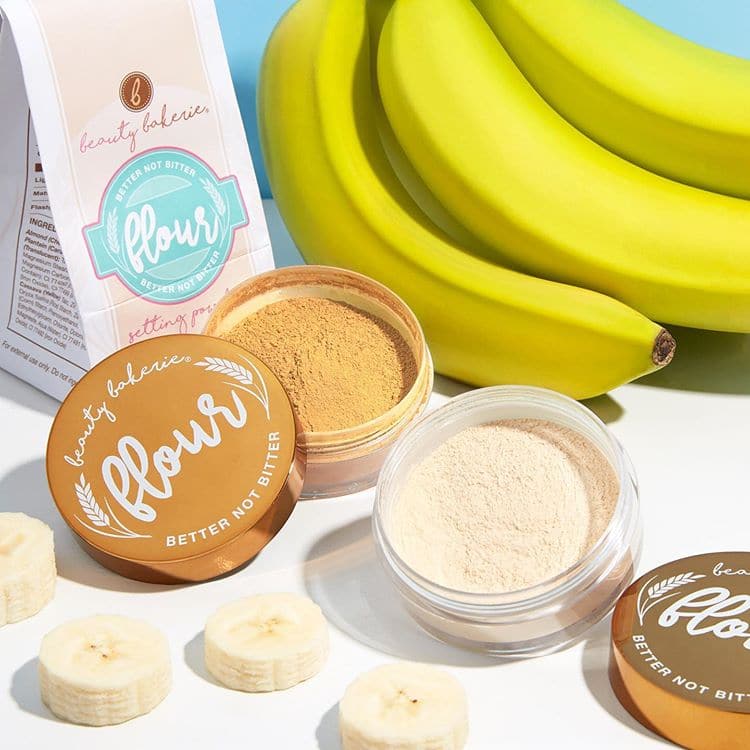
Beauty Bakerie Flour Setting Powder
Instagram: @beautybakeriemakeup

1. Beauty Bakerie

This one is a HUM employee favorite! Beauty Bakerie’s sweet-themed makeup line is vegan, free of parabens, and smudge-proof.

“Their entire aesthetic is so adorable and incredibly unique,” my co-worker Megan exalts. (She’s especially a fan of the Flour Setting Powder.) Our co-founders are also personally inspired by Beauty Bakerie’s founder and CEO, Cashmere Nicole. The company’s motto, “Be better, not bitter,” speaks to her personal resilience as a single mother and cancer survivor.
Unsun Black-Owned Clean Beauty Business
Instagram: @unsuncosmestics

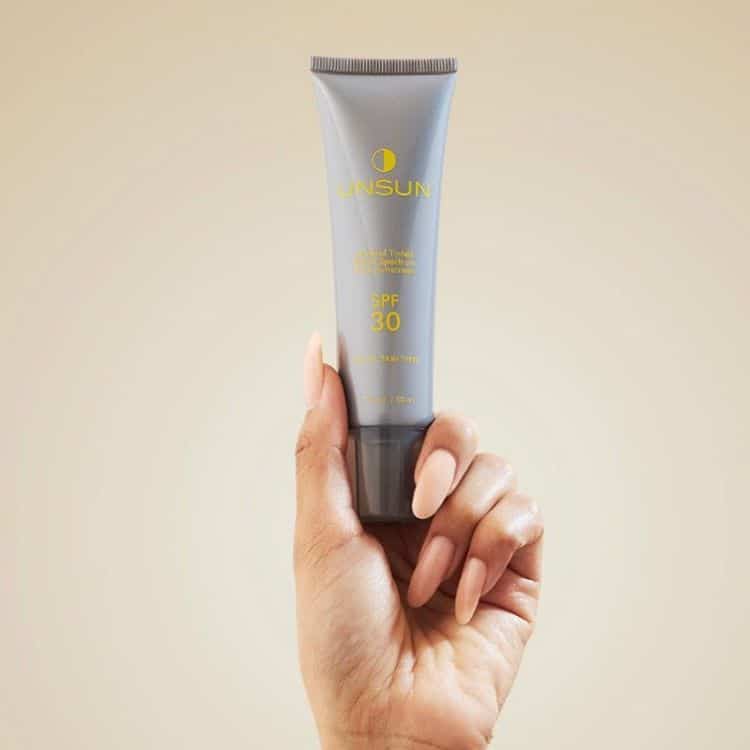
2. Unsun Cosmetics

Mineral sunscreens have been on the rise as a natural alternative to conventional formulas. They work by providing a protective layer on top of skin, as opposed to absorbing into it. For that reason, it’s important for mineral sunscreens to blend with your natural skin tone.

But Katonya Breaux was frustrated by the lack of products created for women of color, so she made one of her own. The Unsun Tinted Mineral Sunscreen acts a primer and color corrector for all-in-one convenience. Texturally, the formula is just right. As one review reads, “Not sticky, not oily, not too tinted…”
Mented Black-Owned Clean Beauty Business
IG: @mentedcosmetics

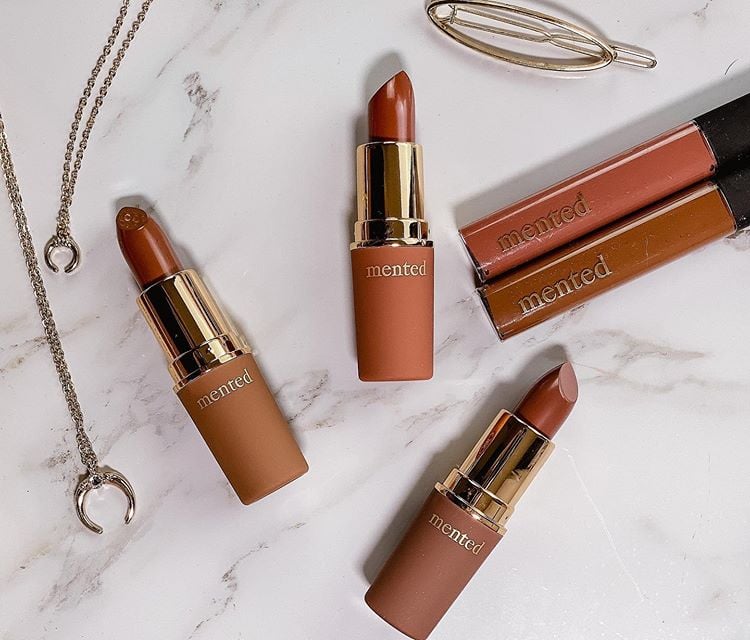
3. Mented

Mented was born with a simple but important mission. Co-founders KJ Miller and Amanda E. Johnson sought to create perfect nude lipsticks for people of all skin tones. Since then, they’ve expanded to offer a full face of makeup including hydrating stick foundations, blush, and a gorgeous everyday eyeshadow palette. Their products are vegan, paraben-free, and non-toxic. HUM employee favorites include the Mauve Over and Berry Me gloss colors.
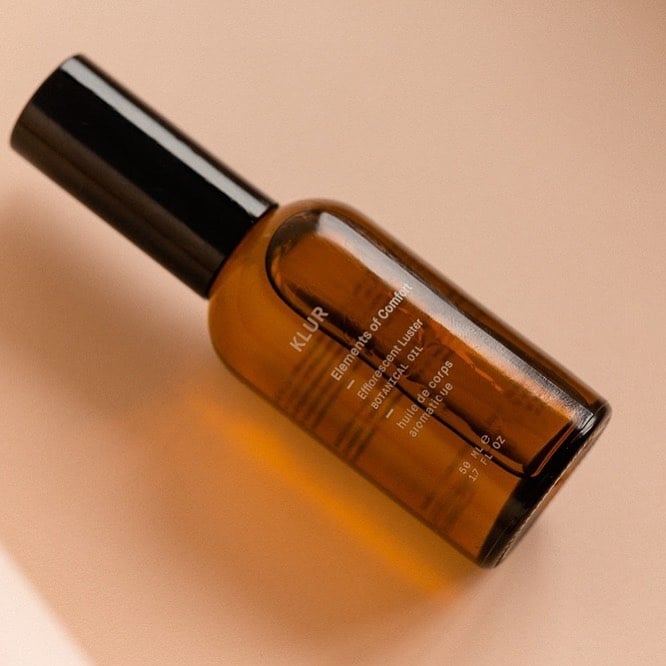
Klur Elements of Comfort Botanical Oil
IG: @klur.co

4. Klur

Klur founder Lesley Thornton got her start as a makeup artist before returning to school to become an esthetician to better understand skin. In her practice, she started carefully formulating products for clients before launching Klur in 2019.

“As an esthetician and formulator, I’ve always treated people with a complete approach to skin health; prioritizing minimalistic regiments that deliver multiple benefits and long-term results,” her founder letter reads.

Indeed, this seven-piece skincare collection is elegantly designed inside and out. It includes a cleanser, oil, serums, and topical skin supplements rich with vitamins and botanicals. All products are free of sulfates, parabens, fragrance, dyes, and fillers.
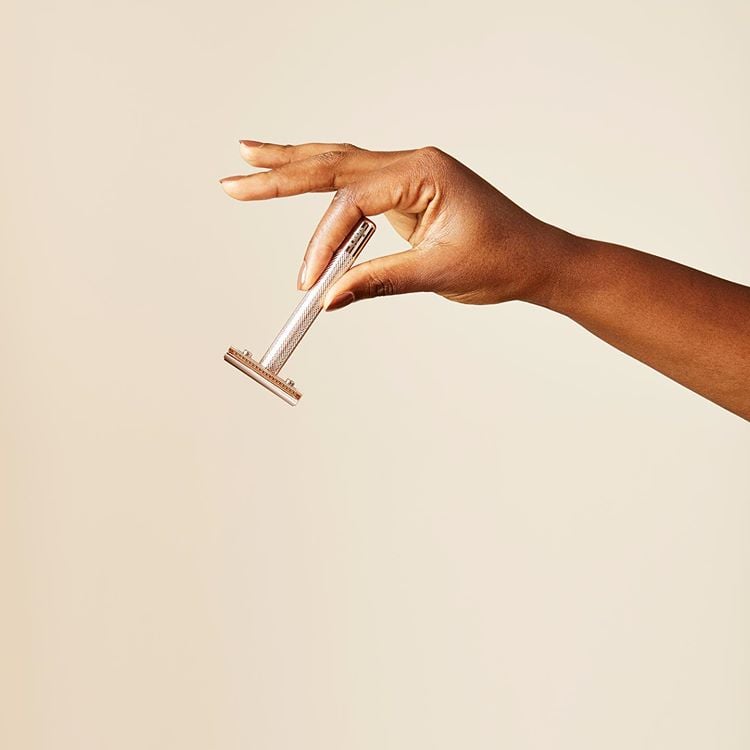
OUI the People Single Razor
IG: @ouithepeople

5. OUI the People

Ditch your plastic razors for OUI the People’s beautiful gold or rose gold razors. The single-blade razors are as efficient as they are stylish, delivering a clean, easy shave.

Along with quality, precision razors, OUI the People also makes a hydrating body gloss, a gel-to-milk shaving solution, and a soothing post-shave sheet mask for your bikini line (!!!). These products are free of phthalates, parabens, formaldehyde, petrolatum, and synthetic fragrances. Plus, they break down their commitment to sustainability—from product to packaging—in detail on their website.

Finally, we really love founder Karen Young’s commitment to using positive language and messaging. No promises of being “flawless” or “perfect” here; just really great products that work. “We believe beauty shouldn’t come at the expense of our psyche,” she writes on their website.
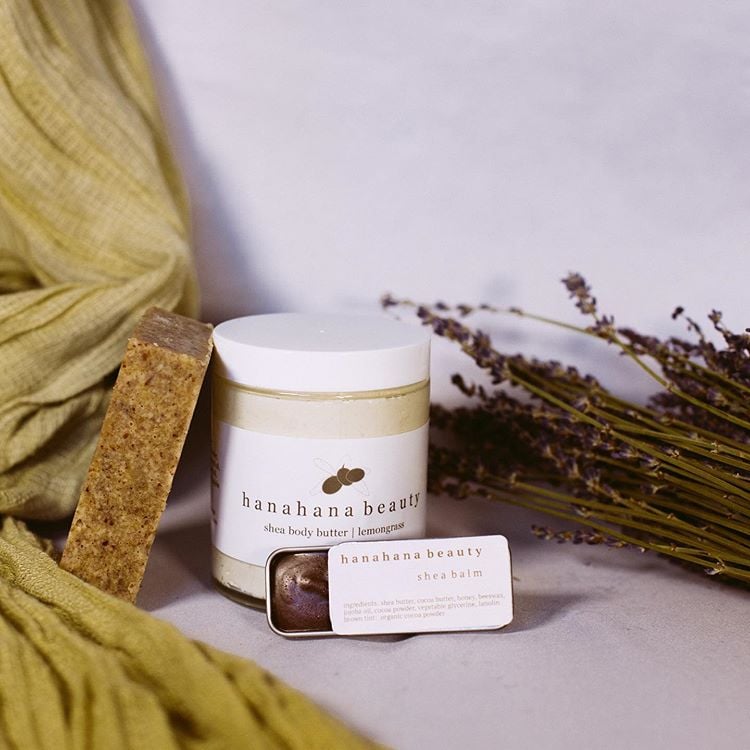
Hanahana Fair Trade Shea Butter
IG: @hanahana_beauty

6. Hanahana Beauty

Hanahana Beauty’s line of shea body butters use shea, cocoa, and mango butters along with grapeseed, avocado, almond, coconut, hemp, and jojoba oils to hydrate and regenerate skin. They use essential oils for fragrance and also make an exfoliating soap bar, skin scrub, and lip balm.

Founder Abena Boamah-Acheampong sources their shea butter directly from the Katariga Women’s Shea Cooperative in Ghana. She pays more than double the fair-trade price and also supports the community with biannual healthcare checks, vaccinations, and health education classes.
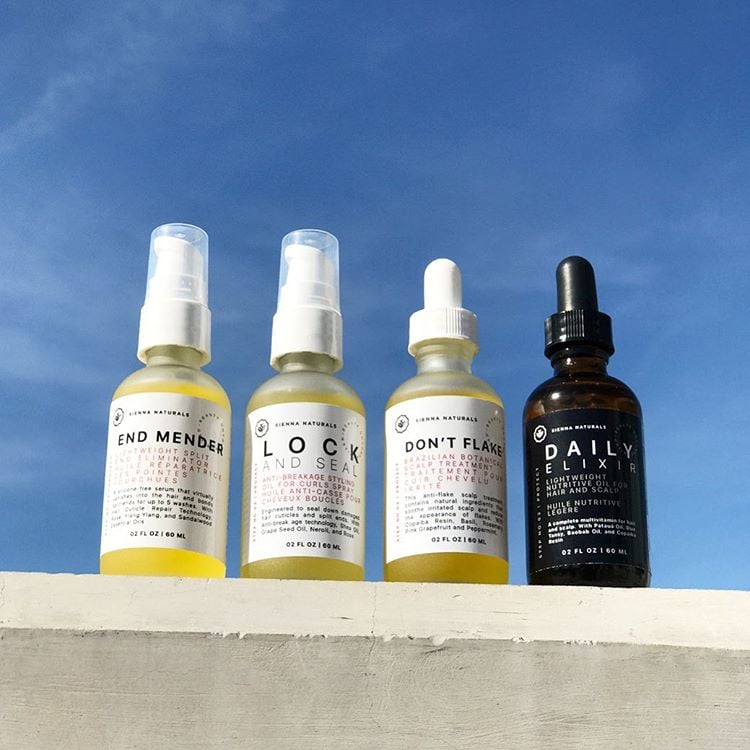
Sienna Naturals Black-Owned Haircare Products
IG: @siennanaturals

7. Sienna Naturals

Founder Hannah Diop created Sienna Naturals to nurture textured hair from the scalp up. Her line includes a shampoo, conditioner, and oils that use ingredients like baobab and pea protein to repair hair and blue tansy to soothe the scalp.

The plant-based line is made without silicones, petroleum, mineral oil, SLS, SLES, dyes, fragrance, phthalates, DEA, and other harsh synthetics. They also work with suppliers to ensure sustainable farming and fair living wages in their supply chain.
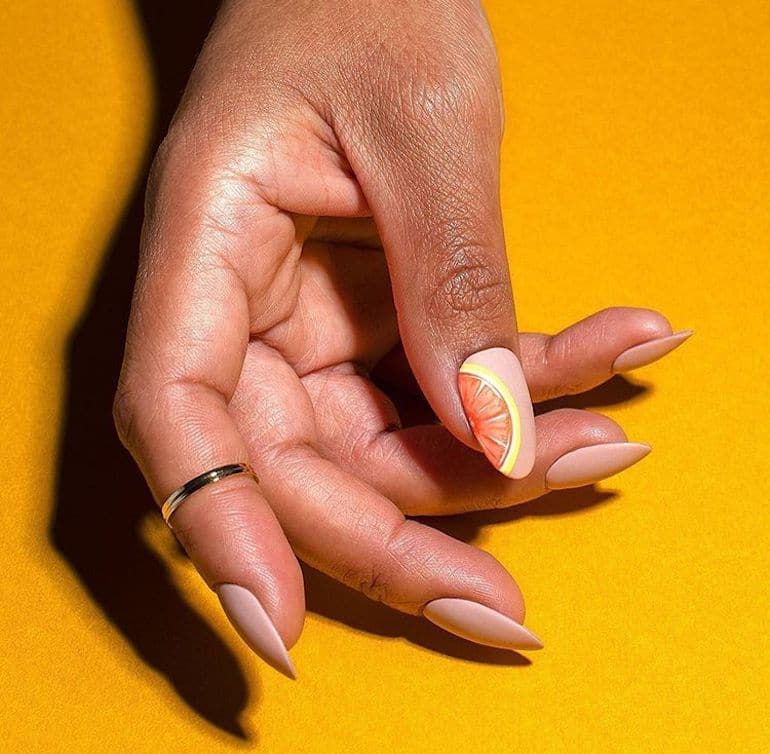
Pear Nova Clean Beauty Nail Polish Art
IG: @pearnova

8. Pear Nova

Founder Rachel James always knew she wanted to work for herself and we’re SO glad she did. Pear Nova’s gorgeous nail lacquers are vegan, cruelty-free, and free of toluene, formaldehyde, formaldehyde resin, camphor and DBP. They also have an equally clean line of gel products for nail technicians.

Colors range from gorgeous nudes of every shade to dreamy pearlescents and bright and bold shades for summer. Personally, I can’t get enough of the color names, which include “Cleo F*ckin Patra,” “Frida Be Free,” and “Michelle Our Mama,” among other themes.
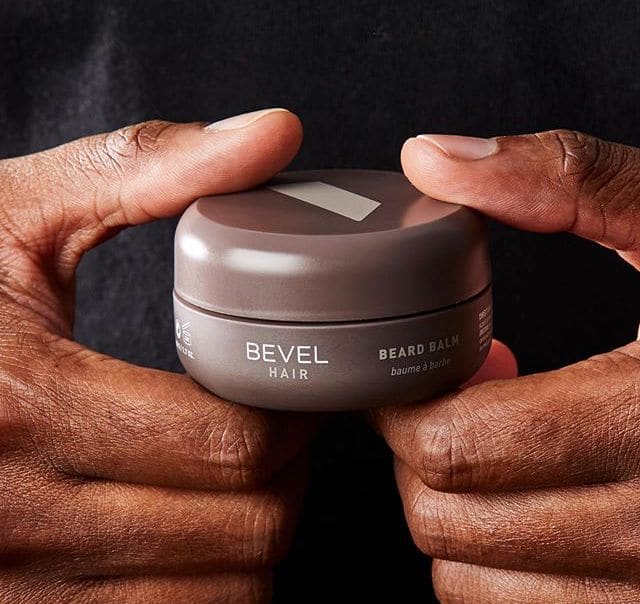
Bevel Natural Men's Grooming Products
IG: @bevel

9. Bevel

Finally, for all your men’s grooming needs, look no further than Bevel.

Founder Tristan Walker worked as a financial analyst and trader before launching Bevel in 2013 out of the desire to create a better shave and to solve grooming problems for people of color.

The sleek Bevel Trimmer is a testament to his success with increased control for better fading and outlining. Likewise, their aluminum-free deodorant applies streak-free and penetrates through textured hair.

Other products include shaving creams and oils, body wash, moisturizers, cleansers, and exfoliating toner with earthy natural scents like bergamot, cassis, and supreme oak. Products are made without alcohol, parabens, phthalates, sulfates, silicones, dyes, and artificial fragrances.

The post 9 Black-Owned Clean Beauty & Grooming Brands We Love appeared first on HUM Nutrition Blog.

]]>
My Results After 30 Days on a Whole-Foods, Plant-Based Diet https://www.humnutrition.com/blog/whole-foods-plant-based-diet-results/ Fri, 08 May 2020 18:34:15 +0000 https://www.humnutrition.com/blog/?p=18162 Is subsisting on a vegan diet with zero processed foods or ingredients really worth it? After 30 days, here are my whole-foods, plant-based diet results. Plus, some tips and resources for anyone brave enough to attempt it. First, what is a whole-foods, plant-based diet? A whole-foods, plant-based diet is one that focuses on minimally-processed plant […]

The post My Results After 30 Days on a Whole-Foods, Plant-Based Diet appeared first on HUM Nutrition Blog.

]]>
Is subsisting on a vegan diet with zero processed foods or ingredients really worth it? After 30 days, here are my whole-foods, plant-based diet results. Plus, some tips and resources for anyone brave enough to attempt it.

First, what is a whole-foods, plant-based diet?

A whole-foods, plant-based diet is one that focuses on minimally-processed plant foods. While some interpretations of this diet may merely limit the intake of meat, it’s most widely interpreted as a vegan diet. Besides animal products, you also want to avoid any artificial ingredients, preservatives, or otherwise processed foods.

Examples of food you can eat on a whole-foods, plant-based diet include:

  • fruits
  • vegetables
  • whole grains
  • legumes
  • nuts
  • seeds

It’s also sometimes referred to as the WFPB diet, for short.

Why I Wanted To Try This Challenge

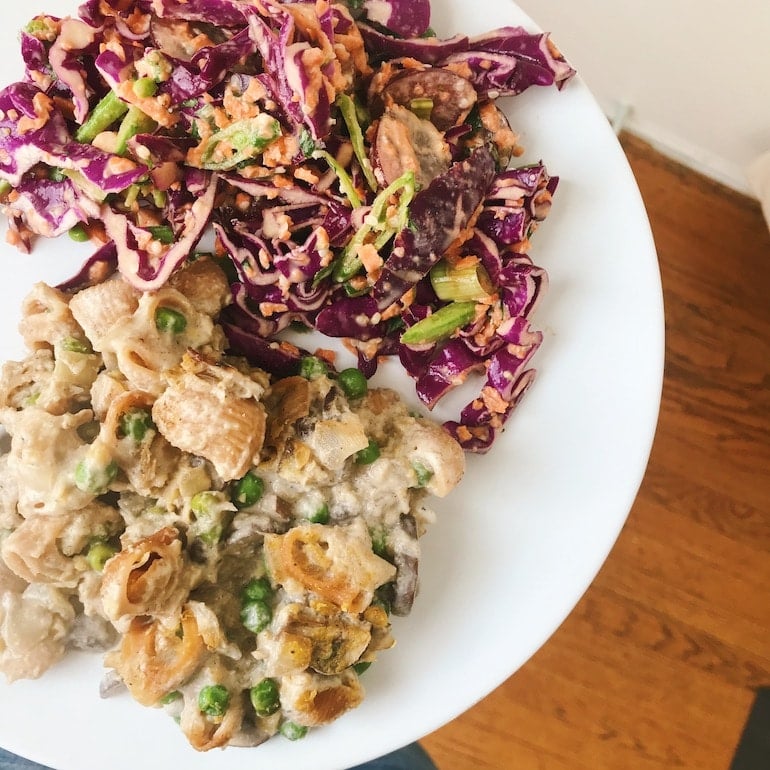
WFPB Vegan Chickpea Noodle Casserole
This chickpea noodle casserole uses a cashew cream sauce and noodles made from chickpea flour.

In truth, I’ve dabbled with vegan diets before. But, the last time I tried a 30-day vegan challenge I pretty much subsisted on Veggie Grill and Erin McKenna pastries. At least, when I wasn’t too busy cheating on my diet outright with cheese… And, okay, fine. There may have also been a late-night vegan Postmates delivery from Taco Bell which wasn’t exactly peak health. Similarly, my more recent flirtations with vegan fare have included a heavy reliance on the wonders of Impossible Burgers and Beyond Meat. 

But, after interviewing Dr. Michael Greger about the merits of a whole-foods, plant-based diet at the start of the new year, I was interested to try a vegan diet the way you’re supposed to, as in, by actually eating vegetables.

In theory, this diet makes a lot of sense to me. It’s good for the environment, nice to animals, and is widely recommended by doctors and anti-aging scientists alike.

30 Day Challenge Rules

For 30 days, I committed to following a vegan diet with minimally processed foods.

Eliminations

Here were some specific items on my list to avoid:

  • meat
  • fish
  • dairy
  • eggs
  • other animal products
  • preservatives and fillers
  • pre-packaged meals
  • sugar and other sweeteners
  • alcohol
  • oil

That’s right! To really avoid processed foods, I even went so far as to avoid alcohol and oil. Why? Because they rely on extraction and distillation negating the “whole goal” of a WFPB diet.

Exceptions

Admittedly, I did make an exception for my daily multivitamin from HUM. There’s always some amount of processing when it comes to making supplements. But with non-GMO, vegan formulas, I felt like this was a fair enough exception to ensure I was getting enough vital nutrients each day.
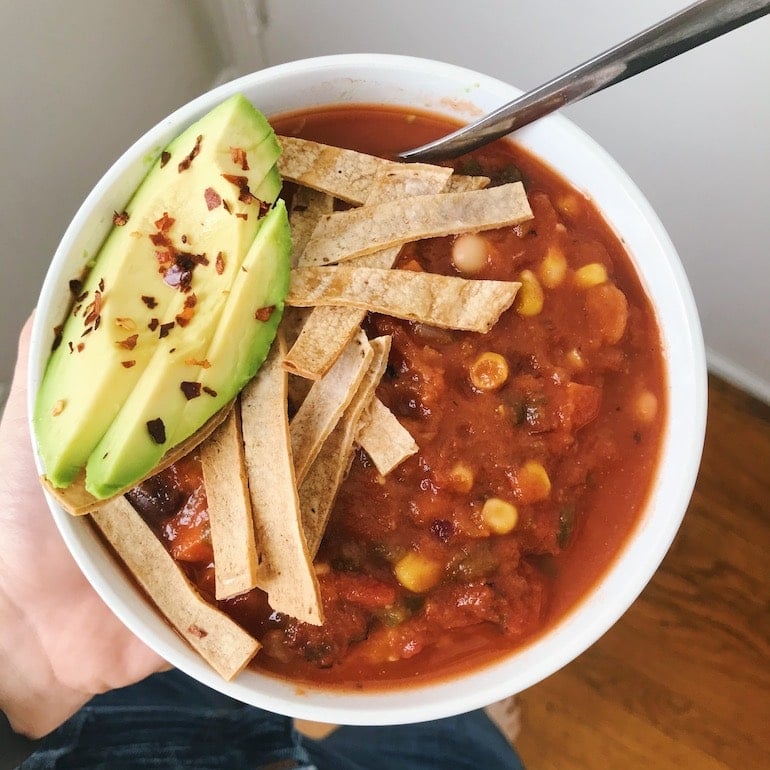
Whole-Foods, Plant-Based Tortilla Soup Recipe
Alex Caspero’s “Weeknight Tortilla Soup” recipe. To make it, I found simple tortillas made with only corn and water!

My Whole-Foods, Plant-based Diet Results

At the end of 30 days, here were my whole-foods, plant-based diet results:

  • I lost 7.8 lbs
  • My waist measurement decreased by two inches
  • My body fat percentage went down by 1.8%

Use the sliders below to see the difference in my before and after photos:

[before_after id=1]
[before_after id=2]

Having tried 30-day Whole30, Keto and no-sugar challenges in the past, these were by far the most drastic results I’ve seen! More importantly, I felt great on this diet. I was prepared to have withdrawals from sugar and processed foods, but the transition was pretty seamless. Throughout the 30 days, my digestion was excellent and I felt a steady lift in my mood and energy.

6 Things I Learned ON a WFPB Diet

Here are some of my learnings on after following a whole-foods, plant-based diet for 30 days.

1. “Minimally-processed” is a very big gray area

The first week of this challenge induced a bit of a philosophical headache. In the quest to avoid processed foods,  I had excluded things like wine, juice, and oil from my diet for not being “whole” plant foods. This seemed in line with the recipes I found for this diet.

Then again, many of the same recipes still included vinegar, or, occasionally, vanilla extract. Didn’t these also exclude plant fibers and go through fermentation processes? Should lemon juice be off the menu for that matter? Also, whole-grain flour seemed overly processed compared to eating cooked rice or quinoa. But spices also undergo drying and grinding process. And isn’t blending, or baking, or cooking a process also?

“Oh yes—we tend to think ‘processed’ is a four-letter word but much of our diet is processed. And that’s okay!” HUM dietitian and plant-based eating expert, Alex Caspero, MS, RD, advised. “Focus more on ingredients and minimizing things like added sugars and salts.”

Following her advice, I decided to continue to omit alcohol and oil but otherwise focus on the ingredients more than the processes behind foods.

2. Skin purging can happen

During the first week of this challenge, my skin broke out in all sorts of places: my cheeks, chin, even the bridge of my nose! When I related these concerns to my trusted co-worker and nutritionist, Sarah Greenfield, RD, CSSD, she gave me a surprising response.

“Oh, that’s great!” she beamed. Why? “That means it’s working!” She encouraged that when we make a sudden dietary change or even add a detoxifying supplement to our routine, it’s normal to experience some purging through the skin.

3. read labels to know your options

Although the majority of my WFPB diet came from fresh produce and bulk bins at the grocery store, the few pre-packaged pantry items I bought taught me the value of reading labels—specifically, allll the labels.

Before, if a recipe called for canned tomatoes, I’d grab any can with “organic” on the label and call it a day. But for this challenge, I learned that even between organic options there are varying degrees of preservatives. The majority are canned with citric acid and calcium chloride but one or two brands on the shelf use only tomatoes. Winners!

It’s worth taking the time to review ingredients for staples like this that you’ll use over and over again. That way, you learn the brands with minimal ingredients and have your go-to’s. Also, it’s not always the brand with the most claims of “all natural” on the front of the label.

4. It’s easier to live without oil than you think

Going into this challenge, I was the most skeptical of cooking without oil for a whole month but it was surprisingly easy to do without. To sauté, I simply added a tablespoon of water or vegetable broth to prevent ingredients from sticking to a hot pan. For baking, you can line baking trays or glassware with parchment paper to achieve a natural and oil-free non-stick barrier.

Admittedly, you don’t achieve quite the exact same crispy texture as cooking with oil but for soups and stews, you would never know the difference.

5. You will save money… but lose time

Because restaurants and alcohol were both off-limits, I saved a ton of money on my monthly dining, delivery, and bar expenses. However, this also meant I was cooking each and every single one of my meals all month long. Even as someone who enjoys cooking and meal prepping, going from preparing 60% of my meals to 100% added a considerable shift of time to my weekly routine. Especially when you factor in the dish washing.

6. Accountability is key

One thing I highly recommend is pairing up with a buddy to try this challenge! Whether it’s someone you live with, a friend to text, or a Facebook group—the camaraderie makes a world of difference. I had a partner who was game to try this challenge with me and the whole month became a fun shared experience instead of a case of total FOMO.
Build Your Supplement Routine
Take The HUM Quiz

Resources

Whole-Foods Plant-Based Cookbooks
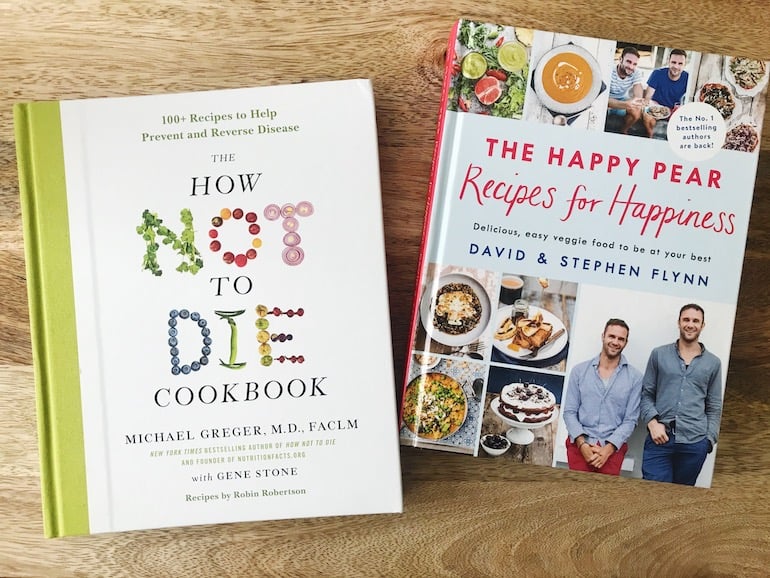
Two of my go-to cookbooks for whole-foods, plant-based recipes!

Here are some resources I found very helpful for following the whole-foods, plant-based diet:

Dr. Michael Greger

Besides being the original inspo for this challenge, I also made lots of delicious recipes from his How Not to Die Cookbook throughout the month.

The Happy Pear

As a food network lover, this whole-foods, plant-based YouTube channel was a dream come true. I also loved their Recipes for Happiness cookbook.

HUM RDs

In addition to answering all of my questions, HUM RDs also had some wonderful WFPB diet recipes! I highly recommend Alex Caspero’s weeknight tortilla soup or Jessica Bippen’s chickpea noodle soup for some delicious whole-food, plant-based eating.

Impressed with our whole-foods, plant-based diet results? Be sure to check out our other challenge results below!

The post My Results After 30 Days on a Whole-Foods, Plant-Based Diet appeared first on HUM Nutrition Blog.

]]>
Here’s What I Eat in a Day on a WFPB Diet https://www.humnutrition.com/blog/what-i-eat-in-a-day-wfpb-diet/ Fri, 08 May 2020 00:06:11 +0000 https://www.humnutrition.com/blog/?p=19224 Want to transition to a whole-foods, plant-based diet, but not sure what your daily options look like? To inspire your inner chef, here’s a look at a sample menu of what I eat in a day on a WFPB diet. My WFPB Diet Guidelines Overall, my whole-foods, plant-based diet challenge focused on following a vegan […]

The post Here’s What I Eat in a Day on a WFPB Diet appeared first on HUM Nutrition Blog.

]]>
plant-based diet, but not sure what your daily options look like? To inspire your inner chef, here’s a look at a sample menu of what I eat in a day on a WFPB diet.

My WFPB Diet Guidelines

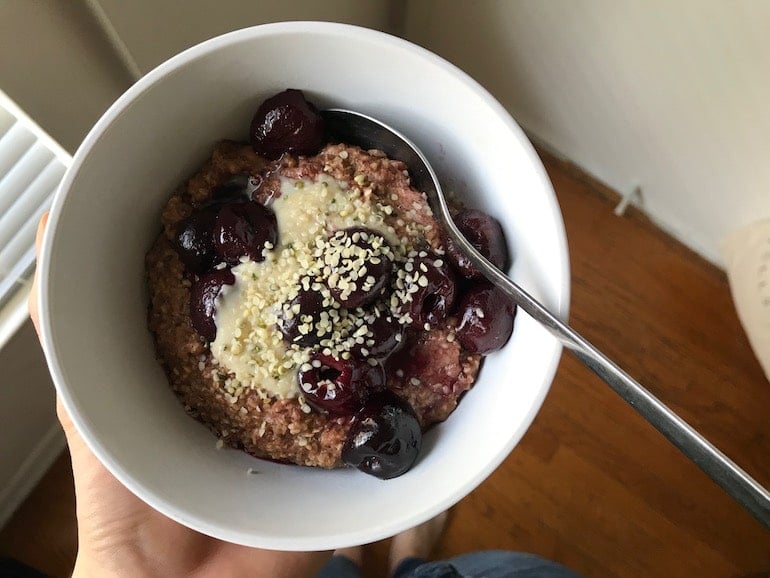
Overall, my whole-foods, plant-based diet challenge focused on following a vegan diet without relying on processed foods and ingredients. Along the way, I learned that “processed” is a highly gray area (who knew baby carrots are processed!?). But for my purposes, I just tried to eat as many plants as possible and avoid any artificial ingredients. To be really extra about it, I also excluded oil, alcohol, and sugar as processed foods from my diet. Oats with berries, hemp seeds, cacao, and nut milk for a good WFPB diet breakfast

What I Eat in a Day on a WFPB Diet

Breakfast

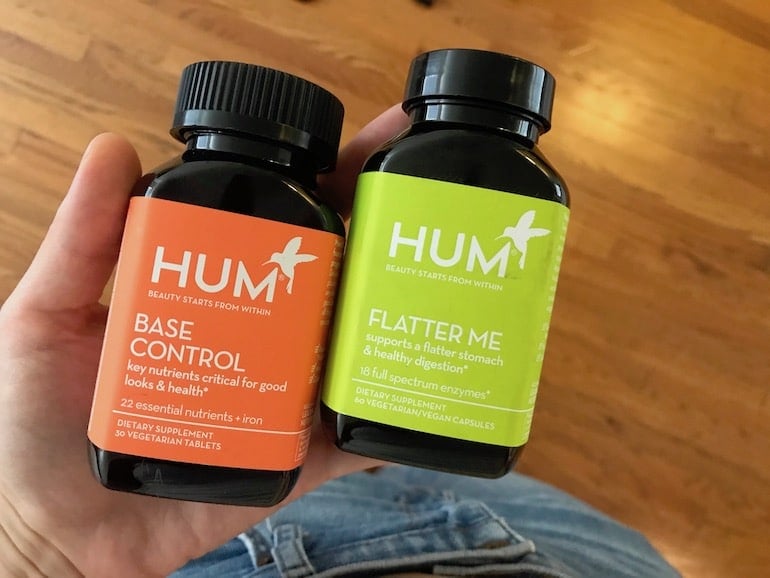
I’ve eaten a bowl of oatmeal for breakfast every day this month. I know! It sounds really boring, but you have to do it right. I switch up my toppings and ingredients to keep it interesting. It’s warm and filling and it helps me feel grounded for the day ahead. Today, I made my oatmeal with steel-cut oats (less processed, more “whole” than rolled oats), hemp seeds (for extra plant protein and omegas), store-bought nut milk, cacao powder, flax seeds, and a scoop of tahini. If you’re a purist, you can make your own nut milk at home, but I just looked for a brand with ingredients of only nuts and water. (Elmhurst’s unsweetened line is a good one!) The same goes for tahini; some brands add oil, so check that there are only sesame seeds on the label. For a naturally sweet oatmeal topping, I like to heat frozen berries with a splash of water in a separate pan while my oatmeal cooks. The berries get nice and juicy, and the juice reduces down to a thick syrup-like consistency. HUM Base Control multivitamin and Flatter Me digestive enzymes

Supplements

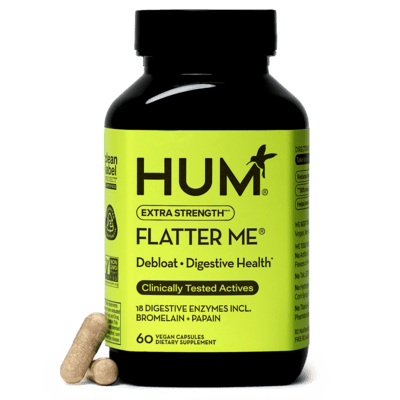
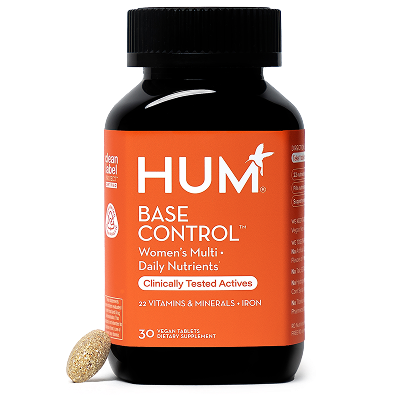
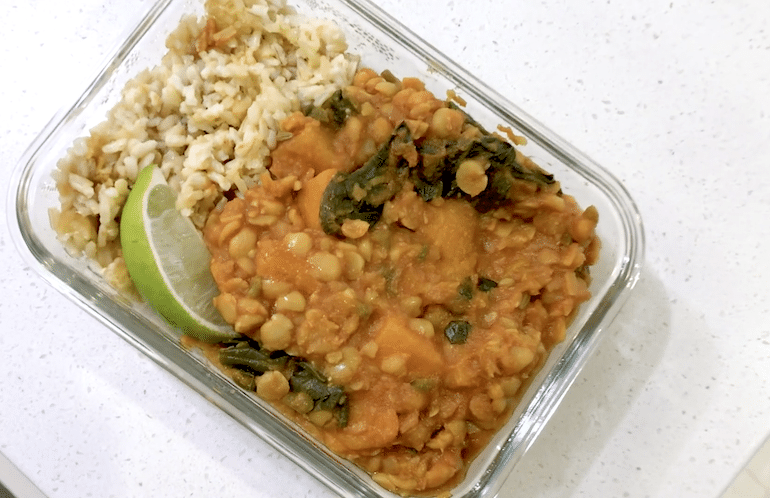
Admittedly, supplements are a processed item. But they are also incredibly helpful in supporting big dietary changes so I’m keeping them in my daily routine as an exception. After breakfast, I take HUM’s Base Control multivitamin. I think of multivitamins as an insurance policy for your basic nutrient needs, especially when you are eliminating food groups on a specialty diet like this. Another supplement I’ve found very helpful during this challenge is Flatter Me. On the WFPB diet, beans are the primary source of protein. You also drastically increase the amount of fiber in your diet due to all the vegetables and whole grains. These digestive enzymes help break down food so it’s easier for your body to digest to avoid issues with gas and bloating. Yellow Split Pea Daal Lunch Leftovers on a WFPB Diet

Lunch

An important thing to know about a WFPB diet is that you will cook… a lot. Even in Los Angeles, it’s hard to find restaurant foods without processed ingredients or oil. To make life easier, I meal prep my lunches for the week so I can easily grab and reheat them. This week, I prepared a split pea yellow daal for lunch. I got the recipe from The How Not to Die Cookbook by Dr. Michael Greger. I like to add pre-cubed butternut squash to his recipe to get an extra vegetable in. If you’re interested in learning more about the benefits of a whole-foods, plant-based diet, I highly suggest reading his books. They are really well-researched and make a great case for adapting a WFPB diet.

Snack

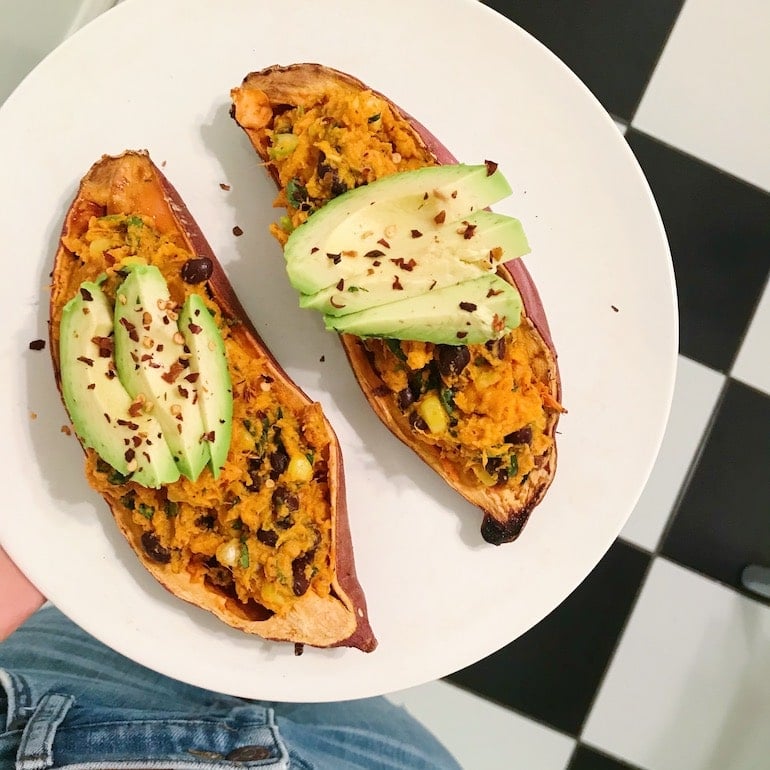
I tend to get snacky around three or four. Prior to my WFPB challenge, I used to indulge in a tall cup of Goldfish. But this month, I am in the habit of cutting up a green apple and having it with a handful of walnuts as my afternoon snack. It’s sweet, crunchy, and very satisfying. The combination of healthy fats and fiber also keeps your blood sugar from spiking and crashing. Stuffed sweet potato WFPB diet recipe

Dinner

For my WFPB dinner today, I’m making a stuffed sweet potato recipe from the Happy Pear. Their YouTube channel has been an amazing resource for recipes! It’s like a little WFPB Food Network. This recipe for baked sweet potato is easy to put together and really tasty. You just roast sweet potatoes in the oven and then scoop out the insides to mix with corn, black beans, cilantro, scallions, jalapeño, lime, and spices. I like to top mine with avocado for extra healthy fat in my day and red pepper flakes for heat.

Dessert

I have a pretty big sweet tooth and thought that would be the hardest part of this challenge. I’ve made a few WFPB desserts but I also avoid any extra cooking where I can. So instead, I usually just have a piece of fruit or some dates and that actually hits the spot! Dates really are like nature’s candy. I know someone will roll their eyes when I say this but, to me, it’s like having a little mini Snickers bar. Yum!

The post Here’s What I Eat in a Day on a WFPB Diet appeared first on HUM Nutrition Blog.

]]>
How to Sharpen Kitchen Knives and Other Knife Care Basics https://www.humnutrition.com/blog/how-to-sharpen-kitchen-knives/ Fri, 01 May 2020 22:19:02 +0000 https://www.humnutrition.com/blog/?p=19135 I love to cook but know next to nothing about kitchen knives. So, I enlisted the help of celebrity chef Mychael Chang to teach me how to shop for, sharpen, and care for kitchen knives. what to look for in Kitchen Knives First, is it really worth it to invest in expensive kitchen knives? In […]

The post How to Sharpen Kitchen Knives and Other Knife Care Basics appeared first on HUM Nutrition Blog.

]]>
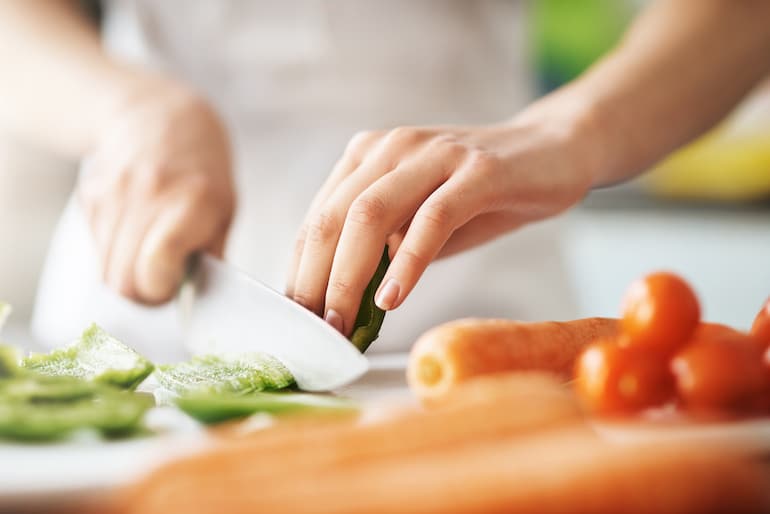
Mychael Chang to teach me how to shop for, sharpen, and care for kitchen knives.

what to look for in Kitchen Knives

First, is it really worth it to invest in expensive kitchen knives? In fact, how expensive your knives are is less important than how well you maintain them. But, there is a difference in performance, fit, and longevity when it comes to pricier knives. “The problem with cheaper knives is usually the blade isn’t going to stay as sharp as some of the better quality knives,” Mychael shares. The blade itself may also be thinner with more expensive knives for greater precision. Also, there’s an ergonomic difference. “I notice a big difference in the fit and feel of the handle.” Whatever your price point, Mychael recommends shopping with a trusted brand, reading reviews, and looking for forged knives.

Forged vs. Stamped

Knives come in one of two varieties. Forged knives refer to those made from a single piece of steel. By contrast, stamped knives have two or more pieces that are forged together. “Personally, I always like the forged knives,” Mychael says. Stamped knives run the risk of developing a loose handle over time whereas a nice, well-maintained forged knife will last a lifetime.

Types of Kitchen Knives

These are the basic types of kitchen knives Mychael recommends investing in to cover all your cutting needs:
  • Chef knife: used for most everyday cutting and chopping
  • 10-inch: useful for cutting into dense or wide materials
  • Slicing knife: for serving cooked meats and fish
  • Serrated knife: to cut through bread or tomatoes
  • Boning knife: for deboning and filleting
Woman chopping vegetables with knife at an angle

How To Care for Kitchen Knives

Here are a few basic rules to help your knives stay sharp and last forever:

Always Hand Wash Your Knives

“Never put your knives in a dishwasher,” Mychael warns. “Never.” Instead, wash your knives by hand, dry them off immediately, and put them away. “I see a lot of people washing knives and leaving them point-down in a drying rack but it’s going to ruin the tip of your knife.”

Never Share Your Knives

“It sounds funny but I never share my knives with other people,” Mychael explains. The reason? Knives actually adapt to our personal grip and movement over time. “The way that you hold a knife impacts how the knife will dull over time,” she elaborates. To keep a clean line, it’s best to use your own tools.

Sharpen Knives Often

“I can’t emphasize how important it is to have a sharp knife,” Mychael says. Some people may shy from sharpening their knives for fear of cutting themselves. However, you actually run a much greater risk of cutting yourself with a dull kitchen knife. “The sharper your knife, the less pressure you need to apply,” she affirms.

How to Sharpen Kitchen Knives

First, you’ll need supplies. Mychael works with a sharpening stone and honing steel. Here’s how to sharpen kitchen knives using these tools:

1. Select and secure a sharpening stone

There are two main types of sharpening stones. One is made with crushed diamonds on the surface and the other is made of stone. With either type, you’ll want to first ensure that your sharpening stone is on a secure surface. (Mychael uses rubber non-slip pads beneath hers for optimal safety.)

2. Wet the surface

Next, you’ll wet the surface of your sharpening stone. Diamond sharpening tools can work with a splash of water while a more classic whetstone requires special honing mineral oil. (This is preferable to olive oil or other food oils, as they will eventually spoil in the porous stone material.)

3. Pull even strokes along the edges

Hold the knife at a twenty-degree angle from the stone and pull it all the way across with even pressure. Apply steady force from the base of the blade to the very tip. Repeat eight to ten times on each side of the blade. If you find that one side is sharper than the other because of your personal grip and cutting habits, do extra strokes on the dull side until it’s even.

4. Finish with a honing steel

The honing steel doesn’t sharpen your blade, but it does help to refine and seal the edges. (Think of it a little like the smoothing side of a nail file.) Alternatively, some sharpening stones have a side with a finer grain that can also be used to hone the edge of your blade in place of a honing steel. To use a honing steel, grasp it firmly in your non-dominant hand. Make sure your fingers are safely beneath the safety handlebar. Just like before, you will pull the edge of the blade along the steel at a twenty-degree angle. Using even pressure, move the entire blade against the steel from base to tip on both sides. Repeat another eight to ten times.

How often should you sharpen knives?

How often you use your knives will determine how often you need to sharpen them. As a professional chef, Mychael typically sharpens hers once a week. Regular home cooks can shoot for once a month as a good goal to start with.

Final Tip

If sharpening kitchen knives still intimidates you, there are professional knife sharpeners you can enlist the help of. Some come to your home for a minimum order while others are available at kitchen supply stores or farmer’s markets. For more practical kitchen tips, follow chef Mychael Chang on Instagram. You can also check out her delicious recipes for avocado gazpacho and this easy chicken paillard recipe

The post How to Sharpen Kitchen Knives and Other Knife Care Basics appeared first on HUM Nutrition Blog.

]]>
Why Ursa Major Chose Vermont for Their Clean Skincare HQ https://www.humnutrition.com/blog/ursa-major/ Mon, 13 Apr 2020 16:21:18 +0000 https://www.humnutrition.com/blog/?p=18814 If you think big cities are the center of innovative skincare, think again. There’s a clean skincare revolution happening from the little known town of Waterbury, VT. What this location lacks in people (only 5,000 residents), it more than makes up for in opportunities to connect with nature. The result? Ursa Major. These personal care […]

The post Why Ursa Major Chose Vermont for Their Clean Skincare HQ appeared first on HUM Nutrition Blog.

]]>

What were you doing before Ursa Major?

My partner, Oliver [Sweatman], and I were both living in New York City and working in the beauty industry before we met. We both loved the hustle, culture, and sense of possibility that big city living offered, but wanted to simplify and be closer to the mountains and family. We bonded over the idea of leaving the city to reboot in Vermont.

Why Vermont?

Oliver and I love spending time outdoors. We’re big believers in the restorative powers of nature. For similar reasons, we try to eat a mostly organic, whole food diet. Vermont’s a great place for us to be. Between the thriving natural food scene, the boom in organic agriculture, the ready access to the outdoors and the emphasis on healthy, sustainable living, there’s plenty of inspiration. Plus there aren’t too many distractions up here so it’s really easy to get into a rhythm and focus on your craft, whatever that may be. When people use our products, we want them to feel like they are getting nourishment, and getting that “breath of fresh air” feeling we get when we take a brisk morning hike in the forest. We believe this is a powerful building block for integrated wellbeing.Mount Mainsfield in Vermont

Why skincare?

Just before moving to Vermont, we both went on a bit of a wellness kick together. As part of that, we began to pay more attention to what was in our personal care products. What we discovered through reading blogs, books, watching videos and talking to experts in the field was pretty alarming. The more we learned, the more concerned we became.

This kicked off a long and frustrating search for clean, effective alternatives to all the conventional stuff we had been using. I think a lot of folks can relate to this on some level! Back then there was a lot of greenwashing and most of the truly clean products—if you could find them—really didn’t work very well. (Or feel, or smell very nice!)

At a certain point, after lots of trial and error, we decided to jump in and try to solve this problem for ourselves. We figured there must be a ton of other folks looking for a better solution and that maybe, with some luck and determination, we could find a way to help.
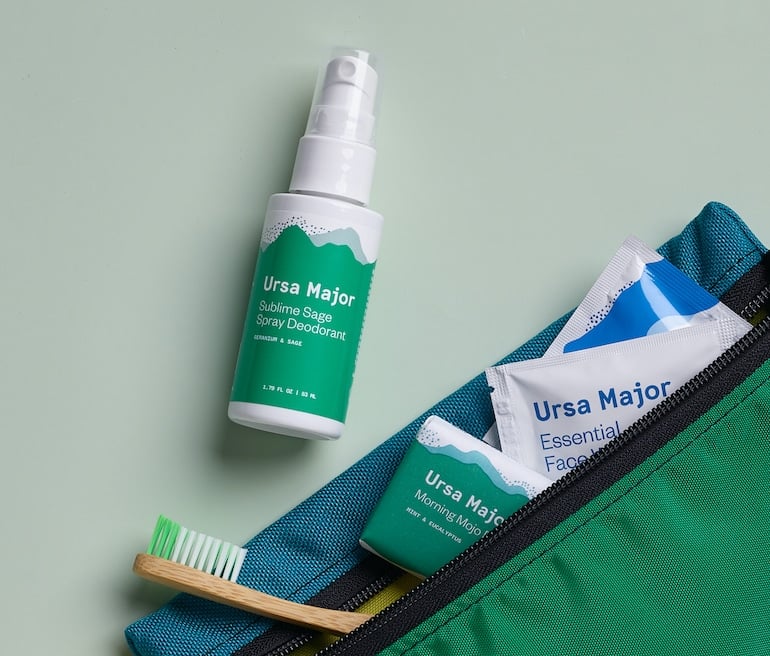
Ursa Major Spray Deodorant

Where does the Ursa Major name come from?

Coming up with the right brand name was really hard! I think we drove a lot of our friends nuts with all the surveys we sent out. After a lot of brainstorming—and a little blind faith—we decided to go with Ursa Major.

Ursa Major means “the Great Bear” in Latin and is also the name of the largest constellation in the northern night sky. For eons, explorers have used Ursa Major as a reliable way to find True North. We see it as a universal symbol that reminds us of our elemental connection with nature and our own journey north to Vermont.

For the brand, we hope it helps evoke the “supernatural” feel of our products while serving as a powerful reminder to follow your inner compass and forge your own path in life.

What are your favorite outdoor activities?

We’re lucky enough to have the Green Mountains right in our backyard. Hiking in the summer and fall is one of our favorite activities. It gives us a chance to clear our heads, stretch our legs, and to observe the wonders of nature—often together as a family with our young daughter, Camilla, and our pup, Lola.

Yesterday, we had a great black bear sighting! And this morning Oliver ran into a moose coming down off the mountain after a long winter. That’s a pretty awesome way to start the day. Exploring all of Vermont’s gravel roads by bike is another favorite way to unwind. In winter we love to go sledding, snow-shoeing, and cross-country skiing on the trails around Stowe.

How are you doing with the shelter-in-place orders?

Thankfully, we live in a spot where the outdoors is readily accessible. When cabin fever starts to set in, we head into the backyard or hit the trails around our house to get some fresh air and fresh perspective. (While keeping plenty of distance from others, of course!)

Forest Scape in Vermont

any tips for bringing the great outdoors inside?

Although we’re fortunate to have access to the outdoors during the quarantine, we’re always looking for ways to bring the outside in as well.

Research shows you can get similar mental benefits from things that remind you of nature, and in some way transport you outside through sight, sound and aroma.

Some of our favorite ways of bringing the outside inside include…

  • having a nice room spray or all-natural candle on hand
  • displaying fresh branches or sprigs
  • placing a few rocks or other finds on the fireside mantle
  • landscape paintings or photography
  • listening to natural soundscapes
  • swiping through the feeds of some of our favorite nature photographers like @chrisburkard and @ben_moon
And of course, a view with some greenery (or just a view of the sky) never hurts! To bring the great outdoors to your personal care routine, check out Ursa Major online or follow them on Instagram

The post Why Ursa Major Chose Vermont for Their Clean Skincare HQ appeared first on HUM Nutrition Blog.

]]>
Here Are The Best Places To Take Online Yoga Classes https://www.humnutrition.com/blog/best-online-yoga-classes/ Fri, 27 Mar 2020 21:52:34 +0000 https://www.humnutrition.com/blog/?p=18589 There really has never been a better time to explore online yoga classes. We’re cooped up inside, stressed out, and likely, spending more hours hunched over our devices. Luckily, yoga is an affordable workout that requires very little equipment and not much space. It gives you the chance to stretch out, breathe, and release tension. […]

The post Here Are The Best Places To Take Online Yoga Classes appeared first on HUM Nutrition Blog.

]]>
study at Lund University in Sweden shared that “yoga practitioners reported significant reductions in stress,” compared to non-practitioners. They go on to conclude that it “appears to be effective for stress” and promotes psychological health among workers. For anyone still shy or skeptical of yoga, don’t knock it until you enjoy the freedom of practicing in your own home. It’s less pressure and puts you in control. (That means of the playlist, too.) As a self-professed online yoga addict, here are my recommendations for where to take online yoga classes:

5 Great Options for Online Yoga Classes

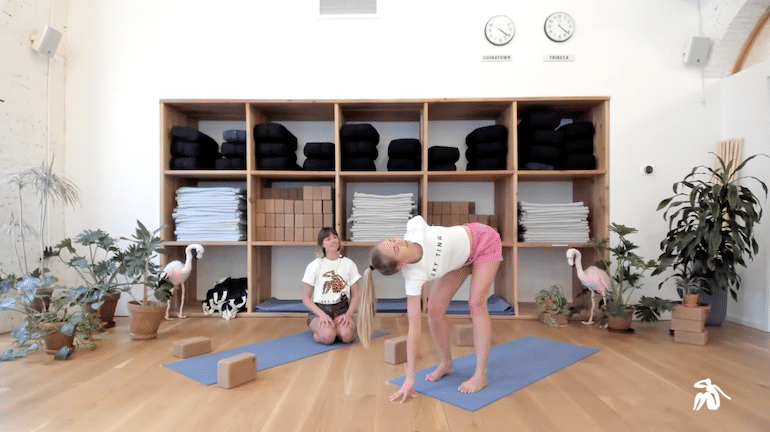
Sky Ting Livestream Online Yoga Class
Image: Sky Ting TV

1. With Your Local Studio or Teacher

There’s very good karma to be had for supporting your local businesses right now. With the sudden onset of social distancing mandates, many yoga studios and teachers around the country have adapted to offer online yoga classes.

I’ve been taking live classes via Zoom with Love Yoga here in Los Angeles. Teachers lead the class from their mat at home and offer verbal adjustments from the live video feed of students. Getting to say hello to my favorite teachers before class and seeing other people practicing at the same time is a huge lift in my day.

In New York, Sky Ting has ramped up production on their online platform, Sky Ting TV. Live hour-long classes are recorded so users can revisit them later. Hip-hop yoga favorite Y7 is offering live classes via Instagram. Meanwhile, other small studios like Yoga Bliss in El Segundo have taken to uploading classes directly to YouTube with links to donate to their studio.

Equally important, many teachers are following suit and offering group and private classes via Zoom or on social.

If you have a local studio or teacher you enjoy practicing with in-person, check their social media to see what remote offerings they have. And if you have the means, please consider donating to support these important studio spaces and teachers.

Pricing: Varies
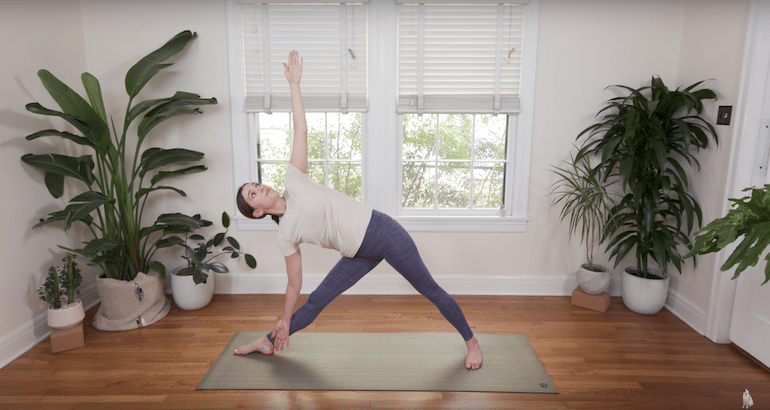
Yoga with Adriene YouTube Yoga Class
Image: Yoga With Adriene

2. Yoga with Adriene

This option is terrific for beginners or anyone on a tight budget. Yoga teacher, Adriene Mischler, has amassed almost 6.5 million subscribers on her YouTube channel over the years. Her online yoga classes are free, accessible, and often include cameos from her canine sidekick, Benji.

Her individual class offerings include pertinent niche topics such as “Yoga For Text Neck,” “Yoga For Gut Health,” or even, “Yoga For Grief.” Alternatively, if you’re looking for a structured way to incorporate yoga into your daily routine, try her aptly named 30-Day series, Home.

Pricing: Free

Glo Online Yoga Subscription with Dice Iida-Klein
Image: Glo

3. Glo

One of the best things about the online yoga subscription site, Glo, is the wide variety of classes they offer. You can easily filter by type of class, length, and level. They offer vinyasa, kundalini, Ashtanga, Katonah, prenatal, or any other type of yoga you can imagine. The teacher selection is impressive with classes from world-renowned, OG teachers such as Annie Carpenter, Richard Freeman, or Seane Corn. (Think, your yoga teacher’s teachers.) Though, my personal favorites include Kathryn Budig, Claudine Lafond, and Dice Iida-Klein.

Pricing: $18 per month after the free 15-day trial
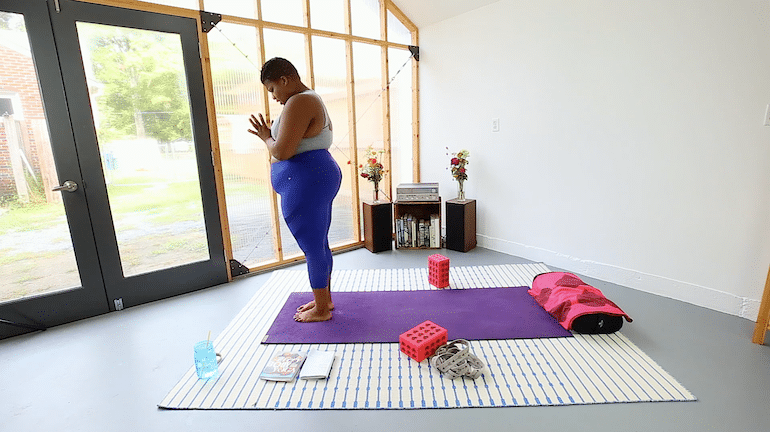
Jessamyn Stanley teaching yoga on The Underbelly
Image: The Underbelly

4. The Underbelly

For anyone who has ever watched a yoga instructor in extra small leggings holding an effortless handstand for and thought, “Yoga just isn’t for me,” Jessamyn Stanely wants you to think again. Jessamyn is a body positivity advocate and author of Every Body Yoga.  Her online subscription site, The Underbelly, dubs itself as “the yoga studio for the rest of us.”

Her classes are organized into three different series by level. Each series has ten classes. Run time varies from thirty to fifty minutes. Class titles include, “Crack open bits of your soul,” and “Make it super f*cking lush.” Count us in.

Pricing: $9.99 per month after the free 14-day trial

Eoin Finn teaching on Wanderlust TV
Image: Wanderlust TV

5. Wanderlust TV

Once known for the summer yoga festival series, Wanderlust TV offers online yoga classes with all of their most beloved teachers. I recommend checking out classes with Eoin Finn, Chelsey Korus, Mary Beth Larue, or Wanderlust co-founder Schuyler Grant.

Wanderlust TV even manages to bring the feel of practicing in the outdoors online. Many classes are filmed on location with beautiful outdoor settings in Oahu, Whistler, Tahoe, and more. Besides yoga classes, there are also meditation courses and Speakeasy lectures to keep your mind uplifted and at ease.

Pricing: $9.99 per month after the 30-day free trial

Looking for more ways to move and unwind? Try foam rolling with tips from Lauren Roxburgh or these five online workout platforms.

The post Here Are The Best Places To Take Online Yoga Classes appeared first on HUM Nutrition Blog.

]]>
How To Make Hand Sanitizer At Home https://www.humnutrition.com/blog/how-to-make-hand-sanitizer/ Tue, 03 Mar 2020 00:13:52 +0000 https://www.humnutrition.com/blog/?p=18121 Today, we’re teaching you how to make a simple but effective hand sanitizer at home using only three ingredients. This thrifty trick is good for your health, your wallet, and the environment. Does hand sanitizer really work? In case you’re skeptical, even studies report impressive benefits. In one study in Tanzania, researchers checked the efficacy […]

The post How To Make Hand Sanitizer At Home appeared first on HUM Nutrition Blog.

]]>
Does hand sanitizer really work? In case you’re skeptical, even studies report impressive benefits. In one study in Tanzania, researchers checked the efficacy of hand sanitizer in communities with limited access to freshwater. Their findings? In fact, they found that “hand sanitizer was significantly better than handwashing” in reducing certain strains of bacteria. In another report, researchers Nina A. Gold from Hackensack University Medical Center and Usha Avva of the  Joseph M. Sanzari Children’s Hospital write that alcohol-based hand sanitizers “are tremendously effective in preventing the spread of the seasonal flu” along with other viral and bacterial illnesses. They also cite a 2017 study from the Journal of Infectious Diseases that supports the use of alcohol-based hand sanitizers “in viral outbreak situations.” Just be sure to look for formulas with at least 60% alcohol content as recommended by the CDC to ensure your hand sanitizer is up to standards.

When Should you Use hand sanitizer?

To be clear, regular handwashing certainly has its rightful place in your immunity routine. That said, hand sanitizers can make for an excellent supplement to your hygienic routine throughout the day. Washing your hands is still the best option for the following scenarios:
  • when soap and water are readily available
  • before and after meals
  • after using the restroom
  • when your hands are visibly dirty
By contrast, consider adding a sanitizing solution whenever water is not available, or as additional support in the following instances:
  • in the car
  • when traveling on public transportation
  • in airports and on planes
  • at the office between meal and bathroom breaks
  • after handling cash and coins
  • at the gym

About This DIY hand Sanitizer Recipe

This recipe combines three simple ingredients to help keep hands germ-free. First, aloe vera gel makes up the bulk of this recipe. You’re likely familiar with aloe vera as a solution to soothing sunburns. That’s because research shows it can help skin retain moisture, reduce inflammation in the skin, and even help heal skin wounds. For this recipe, look for an aloe vera that uses minimal ingredients and is free from any artificial coloring to keep things natural. Then, we include the active ingredient of simple rubbing alcohol. Yet again, we recommend checking the label to ensure it has minimal ingredients and does not include any artificial scents. Instead, we recommend adding your own natural scent with tea tree essential oil. Tea tree oil is known for its antimicrobial and anti-inflammatory properties. While clinical evidence is still lacking in proving its efficacy against illness, it doesn’t hurt to add as a refreshing natural fragrance.

How To Make Hand Sanitizer at home

To make a hand sanitizer at home, follow this simple recipe:

Ingredients

  • 1 1/2 tbsp aloe vera gel
  • 2 1/2 tbsp rubbing alcohol
  • 10 drops tea tree essential oil (optional)

Supplies

  • 2 oz reusable squeeze bottle

Directions

  1. Combine the aloe vera, rubbing alcohol, and essential oil in a small bowl until well combined.
  2. Pour into a reusable squeeze bottle. Carry with you to use as often as you like.

Sanitizer on Your Skin

One final thing that may deter people from using sanitizer is the concern that the constant application will cause dry or irritated skin. In fact, yet another benefit of hand sanitizer is that it can also be gentler on sensitive skin than washing your hands with soap and water just as many times throughout the day. While most soaps focus on stripping skin and also require the friction of washing and drying, hand sanitizers often include moisturizing ingredients and dry quickly on their own without the use of harsh towels. That said, the most effective solutions are still alcohol-based, which can be drying. While the moisturizing ingredient of aloe vera should help keep your skin in balance, if you do experience dryness or irritation, simply follow up each application with hand lotion.

The post How To Make Hand Sanitizer At Home appeared first on HUM Nutrition Blog.

]]>
Real Women Talk About Vaginal Health https://www.humnutrition.com/blog/real-women-talk-about-vaginal-health/ Tue, 18 Feb 2020 20:29:29 +0000 https://www.humnutrition.com/blog/?p=17933 We recently learned that a tragic 65% of women are uncomfortable using the words vagina and vulva. Ladies, it’s time to get comfortable and speak up about our vaginas and their wellbeing. To lead the way, here are six real women talking about vaginal health on-camera. From yeast infections, to UTIs, and menstrual cups, here’s […]

The post Real Women Talk About Vaginal Health appeared first on HUM Nutrition Blog.

]]>
65% of women are uncomfortable using the words vagina and vulva. Ladies, it’s time to get comfortable and speak up about our vaginas and their wellbeing. To lead the way, here are six real women talking about vaginal health on-camera. From yeast infections, to UTIs, and menstrual cups, here’s what they had to say.

Q&A with Real Women Talking About Vaginal Health

How comfortable are you talking about vaginal health?

“I feel pretty comfortable talking about my vaginal health with most people like my friends, or my mom. Obviously, the least comfortable place I would say is here at my work.” – Tiffany “I feel pretty comfortable talking about vaginal health. It’s something that I talk about often with my friends, roommates, and even my mom.” – Brianna “I guess it’s not who It’s more the situation. I don’t usually just bring it up but if it’s out there I’m happy to talk about it.” – Amy “I love talking about the vajayjay! Does anyone else call it that? The flower? My special place? No, but seriously, I could talk about it with anyone, anytime.” – Vanessa

What PMS symptoms do you experience?

“Currently, I’m pregnant so I haven’t been getting those PMS symptoms. When I did it was a real intense craving for chocolate and then I would get really bad cramps the first day of my period.” – Sarah “I experience a lot of bloating. Also, really, really bad cramping to the point where I’m on the floor in the fetal position crying and sweating and in a lot of pain.” – Tiffany “I’ve heard I get a little cranky. I definitely like chocolate. Nothing too severe but I do take Moody Bird.” – Amy “Well, as you get older your PMS symptoms actually lessen. So all I get are cramps and I become very indecisive and I crave chocolate. I don’t know if that’s normal though. I feel like that’s me every other day.” – Vanessa

Do you prefer tampons, pads, or menstrual cups?

“I prefer tampons during the day and I sleep with pads at night.” – Brianna “I prefer period underwear which is absorbent so you are decreasing the amount of waste you have because you’re not changing a pad and a tampon all the time. The menstrual cup thing I can’t do.” – Sarah “Tampons were my sanitary device of choice for many years but I have since switched to a menstrual cup. They can be a little intimidating to get started with but I like the sustainability of it. When I’m wearing one, I don’t even notice it or think about it all day.” – Zena “I prefer tampons. I don’t have a problem with pads. But, I want to try cups because I feel like people really like them these days.” – Tiffany “It all depends on the situation. I just want to be covered.” – Amy “Tampons are more convenient. You just have to mess with them every four to six hours. Pads are in your face. Since menstrual cups are so new I feel like I should get on board. I’m sure all the millennials are doing it. Are they?” – Vanessa

What do you know about vaginal pH?

“I know that it’s supposed to be in between 4 and 4.5 or something?” – Tiffany “I don’t know much about vaginal pH except that you’re supposed to have more of an acidic pH according to things my doctor has told me before.” – Brianna “Less than I should but I feel like it should be acidic? Actually, I just know that because Sarah said it. I really don’t know anything!” – Amy “I know a lot about the vaginal pH. Ideally, we want it to be on the more acidic side. If you’re doing any pH testing we want that number to be lower versus higher. I just tested my vaginal pH and it is 4.0 which is good. Anything above five is when it’s not as acidic as it should be and you’re more open to different types of bacterial infections.” – Sarah

Have you ever had a yeast infection, bV, or A UTI?

“Oh my lord. I’ve had all of these. I once had a yeast infection, a UTI, and my period all at the same time! The nurse that I called just said ‘Oh honey, I’m so sorry.'” – Zena “I was told that I got [yeast infections] as a child but I’m not sure.” – Amy “I have had a UTI. I have had a yeast infection. I’ve never had bacterial vaginosis that I’m aware of…” – Sarah “So, heads up, guys. When you have sex, you have to go pee afterward otherwise you’ll get a UTI. Doctors even say that. It’s a thing! What is it… It’s new fluids going into your urethra and you got to pee ’em out. Otherwise, you will get a UTI and it’s very uncomfortable. Yeast infections I haven’t had since I was a teenager. Thank God. BV I haven’t had since my 20’s… But those UTIs!” – Vanessa

On Unwieldy home remedies

“When it comes to vaginal imbalances, the first thing you do when something feels off is a Google search. Then you dig up a plethora of weird suggestions. I’ve talked about all of these with my gynecologist and she does not recommend any of them. Also, they’re always very messy. Every vaginal home remedy is the messiest sounding thing.”  – Zena “I used to have a girlfriend that lived in Topanga and when she got a yeast infection she would dip a tampon in yogurt and then stick it in there.” – Sarah “I’ve heard apple cider vinegar can be good for yeast infections?” – Tiffany “I’ve heard putting garlic up your vagina is one but I would personally never do any at-home remedies. I go to the doctor.” – Brianna “No one should be sticking anything up there. There’s less than, like, three things that should go up there, honestly.” – Vanessa

Why talking about vaginal health is so important

“As women, we need to be educated about our vaginas. It’s not talked about enough and we need to know what’s going on down there.” – Sarah “We should talk about vaginal health with each other because something that you’re experiencing, your girlfriend might be experiencing. It’s good to know that it’s normal and things that are happening down there are okay. BV is normal. Smells are normal. Things coming out and dyeing your underwear? Normal. It’s all normal.” – Vanessa To learn more about vaginal health from the experts, check out this q&a with a holistic gynecologist or read about how probiotics can support a healthy vaginal microbiome

The post Real Women Talk About Vaginal Health appeared first on HUM Nutrition Blog.

]]>
A Dietitian Answers The Most Googled Questions About Dietitians https://www.humnutrition.com/blog/questions-about-dietitians/ Sat, 18 Jan 2020 00:18:51 +0000 https://www.humnutrition.com/blog/?p=17430 Whether you’re trying to lose weight, improve your skin, or have more energy, working one-on-one with a dietitian is a wonderful way to support your health goals. But as not everyone has had the chance to visit one, it appears that the general population has many looming questions about dietitians and their credentials.  To explain […]

The post A Dietitian Answers The Most Googled Questions About Dietitians appeared first on HUM Nutrition Blog.

]]>
Whether you’re trying to lose weight, improve your skin, or have more energy, working one-on-one with a dietitian is a wonderful way to support your health goals. But as not everyone has had the chance to visit one, it appears that the general population has many looming questions about dietitians and their credentials. 

To explain all about who dietitians are and what they do, here is HUM’s Director of Education, registered dietitian Sarah Greenfield, RD, CSSD to answer the most commonly googled questions about dietitians. (Looking for questions to ask a dietitian? We’ve got you covered here.)
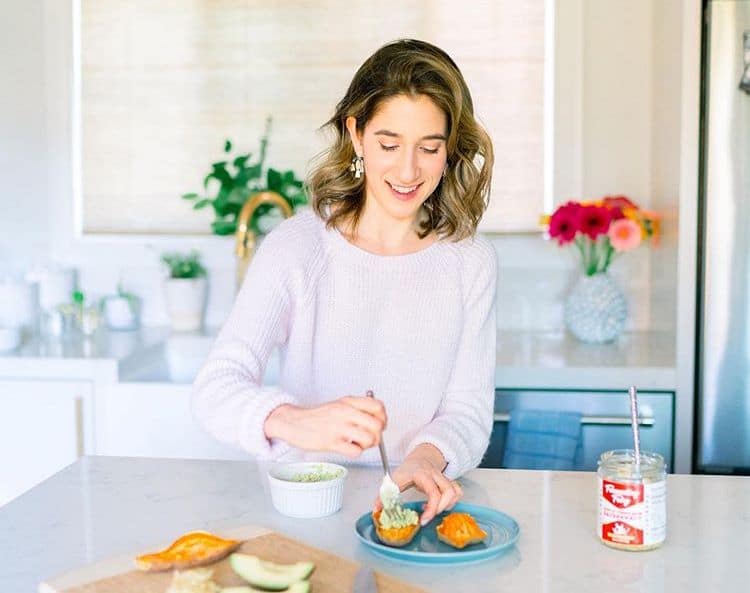
Dietitian Sarah Greenfield preparing food

Dietitian Q&A with Sarah Greenfield, RDN

What does a registered dietitian do?

A dietitian, in my opinion, is primarily a health educator. They help people connect to a healthier lifestyle, giving them the tips they need to make a transformation.

What’s the difference between a nutritionist and a dietitian?

This is one of my favorite questions about dietitians. I answer it a lot.

Basically, it’s an education difference. A nutritionist can really be anybody. There’s not a specific certification that needs to be in place to call yourself a nutritionist. A dietitian, on the other hand, has to go through an accredited program and then take a nationwide exam through a company called the Commission on Dietetic Registration. Once you pass that exam, then you can call yourself a dietitian.

Something that can be kind of confusing is that registered dietitians are now also called RDNs or registered dietitian nutritionists. So, you want to make sure that you understand the difference between the two. Don’t get me wrong, nutritionists are great. I don’t want to discredit someone who is a nutritionist, but a dietitian goes through a much more rigorous training than a nutritionist.

How do you become a dietitian and how long does it take?

All in all, becoming a dietitian is about a five-year process. I did a four-year Bachelor of Science program in Nutrition. Then, after I got my degree, I was able to apply for a dietetic internship at a hospital which took another year to complete.

What skills do you need to be a dietitian?

In my opinion, the skills that you need to be a dietitian are:
  • a passion for nutrition
  • being able to communicate effectively
  • a general love for people
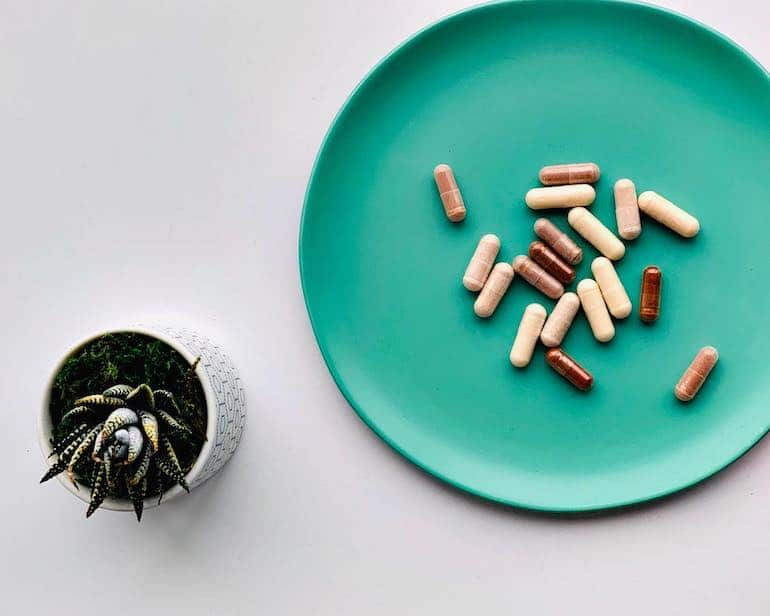
Ultimately, my job is to help people feel empowered in their health instead of defeated by it. Dietitian's supplements on a plate

Can dietitians prescribe supplements?

Yes, dietitians can absolutely create a supplement plan for you. Prescriptions are really more for medications and while a dietitian cannot prescribe medications to you, they can one hundred percent put together a supplement protocol for you.

How can a dietitian help me?

Depending on what you need, a dietitian can help you in many different ways. In my practice, I help people with digestive issues, figure out what food sensitivities they might have, identify where they can make changes to their lifestyle, give them tips to improve digestion or sleep better, and more. It’s really about understanding you as a person, what you need, and then creating a plan and a way for you to hit those goals.

Should I see a dietitian to lose weight?

Yes! A dietitian is the most qualified person to help you with a weight loss journey. Weight loss is a big, big concept. It’s not just about decreasing your calories and exercising more. There’s a lot of emotional things that come up and belief systems that we have in place. A dietitian can help you navigate the food piece, and the movement piece––but also the emotional side. They can connect you with tools that can help you navigate weight loss in a completely different way.

What do dietitians wear?

It depends! In a hospital, dietitians have to wear close-toed shoes and a lab coat. If you’re in your own practice or a corporate setting, you can pretty much wear whatever you want as long as you look put together. You probably don’t want to wear a bathing suit, or a onesie, or pajamas… But barring that, dietitians wear anything that we feel good in.

What are some questions you can ask a dietitian?

You can (and should) ask a dietitian any and everything! Seriously. In my personal practice, I talk a lot about poop. So people ask me, “Why does my poop smell?” or “What should my poop look like?” Those are all welcome questions that I appreciate.

At HUM Nutrition, we pair our customers with dietitians to help advise on your journey to better health. People ask them any number of questions, for example:

  • “Is my breakfast balanced and healthy?”
  • “What are some good snack options?”
  • “What type of nut milk should I use in my morning latte?”
  • “Am I sleeping enough throughout the night?”

They can answer all of these questions and are a really great resource on your journey to better health. The most important thing is feeling comfortable with the person you’re working with and really, any question is a good question. It’s only going to give more clarity to your situation and goals.
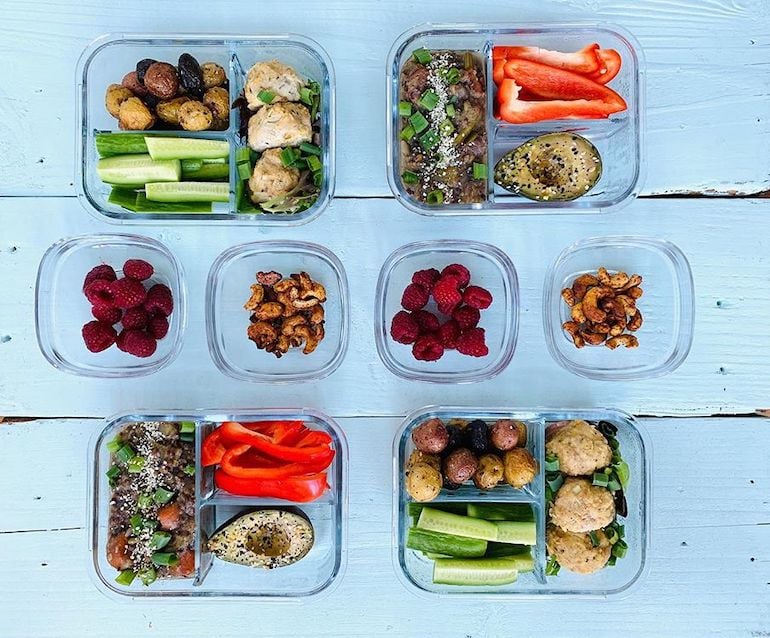
Meal Prep of Dietitian's Meals | The Wellnest by HUM Nutrition

What do dietitians eat?

I always say that dietitians are people, too! As a dietitian, people sometimes look at me and they’re like, “Oh my god, you’re eating that piece of cake!” But I’m a human, I have a sweet tooth. So for me, I try and get more vegetables and balance in my meals as much as possible, but I also don’t limit myself. If you’re curious for specifics, you can check out my food diary of everything I ate in a day.

Are dietitians worth it?

Hell yeah! If you can find a really great dietitian that you connect with, it’s the best investment that you can make in yourself. It’s going to give you so much clarity. Trying to navigate the nutrition world on your own is completely overwhelming. You will get different information depending on where you look. And sometimes, you need a personalized approach and a qualified sounding board. Working with a dietitian is the best.

Have more questions about dietitians? Connect with a HUM dietitian of your own to ask all your questions to when you take this three-minute quiz.

The post A Dietitian Answers The Most Googled Questions About Dietitians appeared first on HUM Nutrition Blog.

]]>